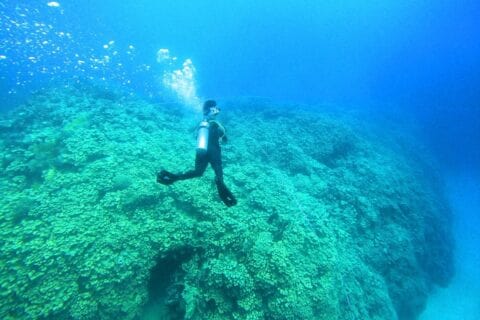

Close scrutiny of the cohabitation living arrangements of a common marine organism — so small it is barely visible to the naked eye — is helping scientists identify factors affecting the health of coral reefs.
Analysing multiple specimens gathered from reefs in Indonesia, the investigation is being undertaken by the national research institute for biodiversity in the Netherlands, Naturalis Biodiversity Center.
The microscopic subjects of this in-depth study are called foraminifera (or forams).
Beaches of shells the size of sand
Beautiful and bountiful, forams are everywhere; and, yet, remain unknown to almost everyone.
They are so ubiquitous that there are entire beaches made up of their tiny shells. This is even more remarkable when you consider a typical foram is only the size of a grain of sand; up to 5mm big.
These single-celled organisms play a huge role in the functioning of marine ecosystems.
There is, however, more than one cell inside the tiny shells. Many forams share their homes with two types of roommate — diatomic algae and bacteria — and scientists want to know how these species work together.
Roommates with algae and bacteria

Foraminifera (forams) spend their lives together with two types of roommate: algae and bacteria.
They are very picky when it comes to the algae, but open-minded when it comes to the bacteria. Understanding this difference makes forams even more valuable tools for monitoring coral reefs.
Like corals, forams build a skeleton, and foster several symbioses with algae and bacteria. Learning more about them helps explain how corals and other living creatures in reefs are affected by their environment.
So, are the relationships between foraminifera and their symbiotic crew specific, or can they change easily?
To answer these questions, researchers collected 243 specimens of six different species of foraminifera from coral reefs in Indonesia. They then analysed the DNA of the algae and bacteria inside each foram.
Fussy with one; flexible with the other

Led by Dr Elsa B Girard of Naturalis Biodiversity Center, this extensive and painstaking research found that the relationship between the foraminifera and their algal partners is very specific.
For each foram species, a single, dominant type of diatom made up more than 90% of the algal community inside the host. This shows that the foraminifera are very selective about their choice of algal roommates. Also, the algal species were rarely found freely living outside the shell, in the surrounding seawater or sand.
It is important to be able to understand exactly how the species interact, explains Dr Girard:
“If it’s inside the foram, we don’t see it in the water, and the other way around. This suggests that this specific relationship is crucial for the foraminifera.”
In contrast to the algae, the bacterial communities inside the foraminifera were highly flexible and diverse, with their composition strongly influenced by local environment factors, such as water depth or seabed type.
However, like the algae inside the shell, these bacteria were not present in the surroundings. The bacterial community presumably has a purpose in the foram, but questions remain as to how, what and why.
Further study could therefore inform our understanding of the wider marine environment, says Dr Girard:
“We suggest that bacterial partners likely play a role in the adaptation of the foraminifera to thrive in a wider range of habitats, but we still do not know to what extent. Because forams are such important indicators for coral reef health, it really helps us if we understand how they work, and why they are where they are.”
The research was published earlier this month in US open-access multidisciplinary journal Science Advances.
Further Reading:
- More on the national research institute for biodiversity in the Netherlands, Naturalis Biodiversity Center;
- More on the full research paper published in the journal Science Advances on September 17, 2025;
- Also on SustMeme, Species discovery in habitat conservation survey;
- Also on SustMeme, AI helps digital twin scale coral reef restoration;
- Also on SustMeme, Biggest biodiversity time-series database 2.0;
- Also on SustMeme, Giant ancient coral colony discovered in Red Sea;
- Also on SustMeme, Continent-wide study of plant life in Antarctica.
Check out the full archive of stories under the SustMeme Biodiversity & Conservation Channel, now available to Sponsor.