
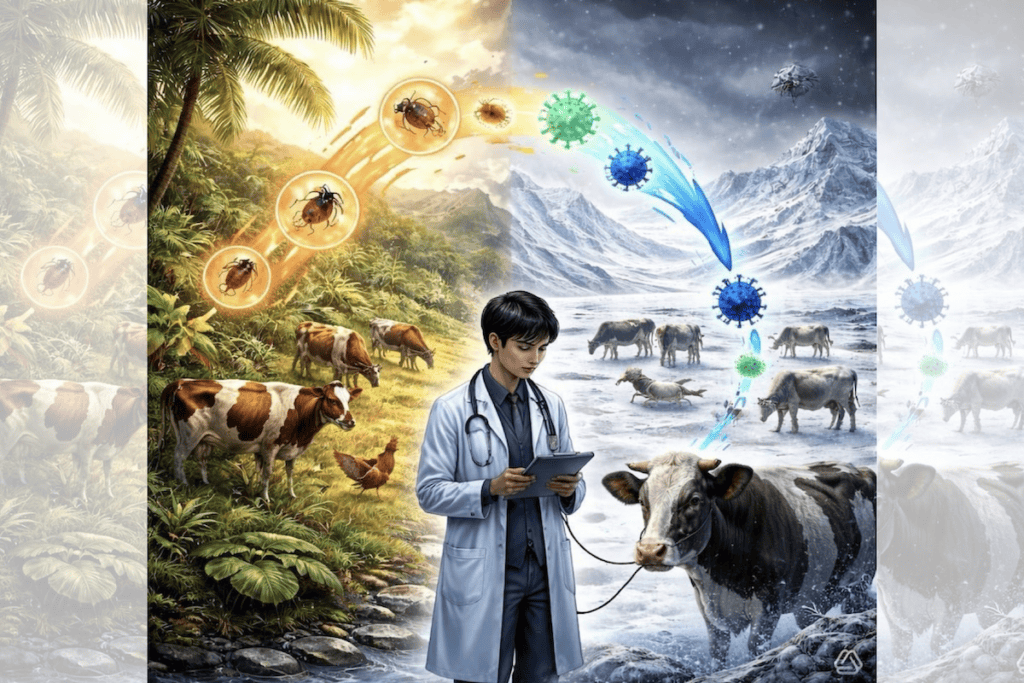
In this SustMeme Guest Post, Jane Marsh, Editor-in-Chief at Environment.co, explores how climate change is redrawing the map for livestock disease across continents, as parasites and pathogens move and migrate.
JM: Global livestock health is undergoing a significant, but overlooked, transformation. While Foot-and-Mouth (FMD) disease remains a primary concern for international trade, climate change has become a massive threat multiplier. As temperatures warm, pathogens can expand and shift their geographic range.
These moves are making regions that were previously considered safe vulnerable to livestock diseases.
Shifting regions, rising threats
Volatile climates fundamentally remap how pathogens navigate regions. Diseases that once occupied narrow equatorial bands are now migrating toward the poles. If left unaddressed, this phenomenon could have dire consequences for food security and the global agricultural economy.
In response, veterinarians find they must now begin studying and preparing to treat diseases that were previously restricted to distant continents. This climate-driven remapping is especially concerning given that the warmest year on record was recorded as recently as 2024.
Migrating pathogens on the move
An example of climate-induced pathogenic migration can be found in Europe. The Bluetongue virus, which was once limited to the Mediterranean region, has begun spreading towards Northern Europe.
Mild winters now allow midges to carry the virus all year round. However, livestock in these areas have not as yet developed any defence against these insects, like they have against FMD disease. This emerging vulnerability is raising concerns about the economic impact on sheep and cattle farmers.
Africa is also seeing similar shifts with Rift Valley Fever. As rainfall and flooding patterns get redrawn due to climate change, they become breeding grounds for mosquitoes carrying fatal diseases.
These health concerns quickly transfer from livestock to humans, creating a potential public health crisis alongside agricultural catastrophe. To build resilience amongst communities and farmers, one important tool for mitigating such risks is predictive modelling that links weather data with veterinary surveillance.
Mobility of invasive parasites
The spread of parasites such as the New World screwworm fly also poses a significant risk to diverse animal populations. These invasive species can travel over 100 miles to lay eggs in their adult form, creating infestations that cross borders and can infect almost any warm-blooded animal, including horses and dogs.
These parasites and disease-carrying insects often proliferate in warm climates. So, the ongoing warming of the oceans is allowing vectors that carry infections to survive in locations and seasons where they previously could not. Farmers in temperate zones are therefore seeing pests that did not previously occur there.
This biological shift underscores the urgent need for agricultural institutions to reevaluate their vaccination schedules and pest control methods, further underscoring climate change’s profound impact on the sector.
Emerging solutions and adaptation
Importantly, though, no one country, region, or sector can tackle the issues alone. Solutions call for international cooperation to meaningfully address these emerging threats. Emphasis must be placed on fully integrated surveillance systems that use satellite imagery alongside on-the-ground veterinary reports.
Furthermore, vaccination protocols and formulations are being reworked to combat emerging strains, on an ongoing basis. Fundamentally, time is of the essence, and such innovative and data-centred approaches crucially help ensure preventive measures can be taken before full-scale outbreaks.
Policymakers have an important role to play, too. They must prioritise cross-border health initiatives to safeguard the global food supply. Disease and climate change do not consider borders, so there must be government initiatives that ensure livestock diseases are properly contained and managed.
Investing in local veterinary infrastructure is a critical line of defence against widespread outbreaks.
Respond today for a resilient tomorrow
Evidently, global climate change affects a multitude of sectors and industries — but, it does so in different ways. The various impacts do not necessarily impact all parties the same, or even at the same time.
It is therefore vital that key players understand the evolving dangers of this climate-driven shift and address them appropriately, if we hope to ensure that the global food supply stays resilient for years to come.

Jane Marsh is Editor-in-Chief of Environment.co, where she leads the publication’s mission to make sustainability accessible and actionable for readers worldwide. With a background in environmental journalism and communications, Jane has spent her career exploring the intersection of technology, policy, and sustainable living. Jane is passionate about advancing awareness around clean energy transitions, circular economy practices, and the future of green infrastructure. Under her editorial direction, Environment.co continues to highlight the people and tech driving a more sustainable planet.
Further Reading:
- More about features and news on Environment.co;
- Also on SustMeme, Investors in autonomous vehicles bet the farm;
- Also on SustMeme, Scientists call for revolution in toxicology and food;
- Also on SustMeme, Food security and the wriggle of the red flour beetle;
- Also on SustMeme, Data at heart of collaboration on climate change (in AFOLU);
- Also on SustMeme (by Jane Marsh), Heat of the night: How bad sleep hits hard at work;
- Also on SustMeme (by Jane Marsh), Bats in the city: Why urban areas become havens;
- Also on SustMeme (by Jane Marsh), Does outsourcing add up for construction waste?
- Also on SustMeme (by Jane Marsh), Microgrids fuel guilt-free holiday-season resilience;
- Also on SustMeme (by Jane Marsh), Why is it still so hard to recycle rare earth metals?
- Also on SustMeme (by Jane Marsh), Pharmaceutical pollution: Medications in our water.
You can check out the full archive of past Guest Blog posts here.
Would you like to Guest Blog for SustMeme? For more info, click here.
SUSTMEME: Get the Susty Story Straight!