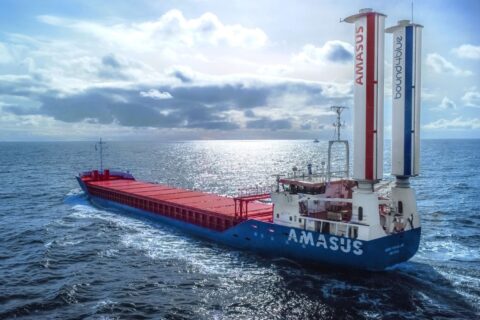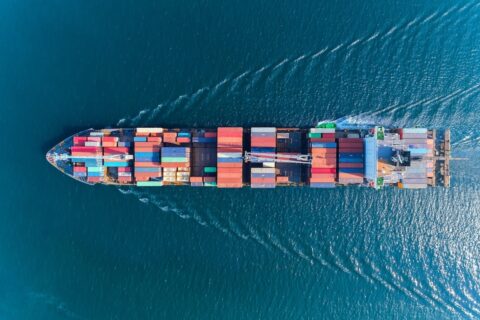

In this SustMeme Guest Post, Sjoerd de Jager, Managing Director and Co-Founder at PortXchange, explains why ports — which lie at the heart of trade, logistics, energy and cities — are the climate blindspot hiding in plain sight.
SdJ: Ports rarely make headlines as climate actors. When they do, it is usually because something has gone wrong: fires on container ships, containers lost at sea, blocked waterways, or local air-quality crises.
This is an issue because ports sit at the overlap of global trade, logistics, energy systems, and cities. If we are serious about decarbonising the economy, ports need far more attention than they currently get.
The World Resources Institute does not mince words. It has described ports as a “major polluter”, “seldom prioritised” for climate action; but also as an “untapped resource” for accelerating the energy transition.
This contradiction should make the industry uncomfortable.
Ports are effectively both part of the problem and part of the solution. The differences lie in whether we treat emissions data as a reporting obligation or as operational infrastructure.
Responsibility — climate blindspot
Ports and shipping together remain a material source of global emissions, contributing roughly 2–3% of greenhouse gases (GHGs) — as a share of total GHGs, this is comparable to global aviation. It amounts to a significant climate impact and a disproportionate health challenge for nearby cities and communities.
Leading climate networks such as C40 Cities argue that port emissions must be included in climate planning and action to unlock deep decarbonisation across urban and transport systems.
So, offering a win-win for sustainability, cutting port emissions serves both global climate benefits and local health gains. Despite this, however, ports remain largely absent from climate policy debates.
One reason is complexity; port emissions do not come from a single chimney, but are spread across ships at berth and at anchor, terminal equipment, trucks, barges, rail, and hinterland connections.
As responsibility is shared, accountability is easy to dilute.
In short, when everyone is responsible, no one really is.
Fragmented data and action
Most ports still collect emissions data in silos. Shipping data sits in one system, terminal energy use in another, and truck and rail movements somewhere else. The result is fragmented emissions tracking, built on ad hoc studies with inconsistent assumptions and data outdated almost as soon as it is produced. With information this patchy and retrospective, ports default to compliance mode instead of operational action.
This is not about a lack of ambition.
In practice, the biggest barrier is access to reliable, comparable emissions data.
Without an integrated view across Scope 1, 2, and especially Scope 3, the true carbon footprint remains hidden. Ports end up optimising at the edges, installing rooftop solar or replacing a handful of vehicles, while the biggest emission drivers remain unseen and untouched.
Data consolidation may not sound exciting, but it is essential.
If ports do not trust their numbers, they cannot prioritise investments, justify infrastructure upgrades, or have credible conversations with shipping lines, cargo owners, the port community, and regulators.
Compliance is not strategy
Regulation is tightening fast. International Maritime Organization (IMO) requirements, the EU ETS, and the EU’s CSRD Omnibus and ESRS-E1 rules are raising expectations on disclosure and accountability.
Banks and financial institutions are adding further pressure, increasingly requiring credible emissions data as a condition for financing infrastructure, energy projects and expansion plans.
This is necessary, but it is not sufficient. Reporting on emissions does not reduce them.
What is changing, however, is how ports interpret this pressure.
More port authorities now recognise emissions management as a strategic issue rather than a box-ticking exercise, not because regulation demands it, but because capital, customers and communities do.
Without credible emissions insight, ports struggle to secure financing, justify long-term investments, or demonstrate their value in a decarbonising economy.
Emissions data is becoming a prerequisite for strategy, not just compliance.
Ports face significant decisions regarding shore power, electrification, alternative fuels, grid upgrades, and digital infrastructure —long-lived, capital-intensive decisions that will shape port operations for decades.
Getting them wrong locks in emissions and stranded assets; getting them right accelerates decarbonisation while protecting competitiveness. Emissions insight allows ports to stress-test options, understand trade-offs, and sequence investments in a way that aligns climate impact with operational reality.
Scope 3 — the real battleground

For most ports, Scope 3 emissions account for the majority of their footprint.
Ships, trucks, rail and logistics partners dominate the numbers. As a result, these emissions are also the most uncomfortable, because they sit outside a port’s direct control.
Ignoring Scope 3, however, is no longer viable. Cargo owners are demanding transparency in supply chain emissions, shipping lines need credible data for their own reporting. Investors and regulators increasingly look beyond the port gate. Without Scope 3 visibility, ports risk optimising locally while failing globally.
This challenge is exactly why we developed EmissionInsider at PortXchange,.
Ports told us the same thing again and again: emissions data existed, but it was fragmented across organisations, systems, and spreadsheets, making it impossible to act on.
EmissionInsider brings operational emissions data from ships, terminals, trucks, and rail into a single, trusted view, breaking down organisational and technical silos that have held ports back. This is where ports can step up as climate actors. By providing a neutral and credible picture of emissions across the entire port ecosystem, ports can align stakeholders around shared facts instead of competing assumptions.
Transparency creates pressure, but it also creates opportunity. Real collaboration only becomes possible when everyone is working from the same numbers.
Digitalisation — intent into impact
Digitalisation is the bridge between climate ambition and operational reality.
Just-in-Time arrivals are a clear example. Studies consistently show that sharing arrival and service data even 24 hours in advance can cut fuel consumption and emissions by around 4-6% per port call. That is meaningful climate action achieved through coordination, not new fuels or offsetting schemes.
What makes digitisation a true solution for sustainability in ports is data sharing. When information about operations and emissions are shared, emissions reductions become more visible, measurable, and credible.
As a result, digitisation shifts from back-office efficiency to a strategic enabler, positioning ports as accountable leaders in the energy conversation.
Data transforms sustainability from an annual report into a daily operational discipline.
Standards and comparison
One of the sector’s biggest challenges is the lack of common standards. Ports still calculate Scope 1, 2, and 3 emissions in different ways, making comparisons unreliable and collaboration harder.
Ultimately, the industry needs a global benchmark so ports can be assessed on the same terms.
We should not wait for perfection. Frameworks such as the GHG Protocol and ISO 14083 already provide a solid foundation. What matters now is consistency, transparency, and the willingness to share data.
Imagine a world where ports can be compared on emissions performance, efficient ports are rewarded, and where shipping lines and cargo owners factor carbon intensity into port choice.
That kind of visibility would change behaviour faster than most regulations ever could.
From reporting to reduction
We have seen this work in practice. Ports that confront their full emissions footprint move faster from disclosure to action. Coordinated port calls cut idle time. Transparent data supports smarter investment decisions. Collaboration across the supply chain turns efficiency gains into measurable CO2 reductions.
The message is simple: ports are not a sideshow in the climate debate; they are a key player.
But that comes with responsibility.
As I often say: Efficiency on paper means nothing if it does not deliver fewer tonnes of CO2 in the air.
The tools exist. The data exists. What is missing is the willingness to connect them and to accept that climate leadership starts with operational truth, which may be an inconvenient one. Being transparent and honest about the port’s footprint demonstrates true courageous leadership and will pay off in credibility.
Ports need a seat at the climate table, whether they like it or not.
They are often public bodies, critical to national economies, deeply embedded in the cities and communities around them. Their decisions shape trade flows, air quality, energy demand, and local livelihoods.
With that influence comes responsibility. Ports cannot stay on the sidelines of the climate conversation, nor can they hide behind fragmented or incomplete data. They need a clear answer to a simple question: what role will they play in supporting the transition towards a liveable climate for all?
Emissions data is no longer an excuse for inaction; it is the foundation for leadership.
Our climate future will be won at the dockside.

As CEO and Co-Founder, Sjoerd de Jager leads PortXchange, a certified B Corp focused on digital solutions for maritime logistics. Skilled at tackling complex problems and rallying people to collaborate, he has emerged as a key thought-leader in maritime sustainability. His contributions are shaping the future of maritime logistics, based on actionable decarbonisation strategies. Established in 2019 with support from Shell and Maersk, PortXchange originates from Pronto — a collaborative vessel and terminal planning platform designed by Port of Rotterdam. As a digital emissions monitoring platform, PortXchange encourages ports and shipping companies to collaborate to achieve just-in-time sailing and reduce CO2 and NOx emissions.
Further Reading:
- More about the digital emissions monitoring platform PortXchange; and its EmissionInsider;
- Also on SustMeme, Hybrid icebreaker vessel for Arctic environments;
- Also on SustMeme, Suction sails on cargo ship cut carbon and cost;
- Also on SustMeme, Energy-saving methanol supply for green shipping;
- Also on SustMeme, Green berthing area for Port of Hamburg moors ships off-grid;
- Also on SustMeme, Bike across the Baltic Sea on a solar-electric ferry;
- Also on SustMeme, Hydrofoils can help electric ferries fly across the sea.
You can check out the full archive of past Guest Blog posts here.
Would you like to Guest Blog for SustMeme? For more info, click here.
SUSTMEME: Get the Susty Story Straight!