
In this SustMeme Guest Post, contemporary artist Emma Lamb explores and explains the power of art to create an emotional connection with a critical environmental issue — one strong enough to spark climate action.
EL: There is a reason art has been around forever; it feeds a need. Since the dawn of human existence, art has served as a reflective lens, depicting the world around us, and questioning our place within it.
The earliest forms of art created on this Earth reveal our deep connection to nature — and, importantly, they emerging during a time when humanity was not actually the central focus of existence.
Back then, our survival depended on knowledge of and coexistence with the environment. We lived with a sense of being a part of a larger ecosystem, not as rulers of an apparently infinite set of resources.
Cave art in times of coexistence

Ancient art was not only inspired by nature; it also incorporated nature itself into its very fabric by using materials that were readily available in the environment, such as rock and charcoal.
Artworks depicted human forms, handprints, and a variety of animals, (some now extinct). Through cave art, we find a tangible trace of place and time, encapsulating experiences and emotions of early artists.
Microplastics and seagull skulls
As an artist myself, I am inspired to create work that not only taps into this primal instinct of empathy, but can also spark conversations and help to build awareness and drive change on environmental issues.
The artwork Tideline Trace, for instance, encourages us to reflect on our human impact on the natural world. It acts as a reminder of the profound and alarming damage that plastics inflict upon our oceans.
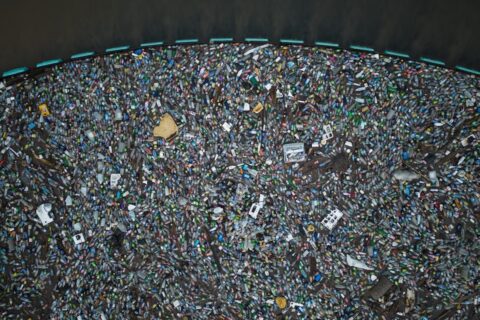
In particular, this 3D piece from my series Tipping Point highlights the escalating environmental crisis posed by microscopic fragments, often invisible to the naked eye. Sadly, the phrase ‘out of sight, out of mind’ encapsulates the current reality in which these tiny pollutants are quietly suffocating the ocean.
Tideline Trace offers a tangible representation of this key environmental issue — all too often overlooked.
Foraging for shoreline fragments


Through my artistic process, I forage the coastline, meticulously collecting microplastics washed ashore. I then embed these fragments into my sculptural works, crafted from handmade cast paper.
In Tideline Trace, viewers gradually uncover hundreds of hidden pollutants, prompting a deeper reflection.
The paper castings feature intricate representations of sea creatures and seagull skulls, which emerged from a profound encounter with a skeleton on the shoreline, tragically consumed with microplastics.
This haunting experience inspired the creation of the piece where the skeletal, fossil forms symbolise the fragility of life in the ocean, while the embedded microplastics serve as a stark reminder of our actions.
Each element tells a story of loss and resilience, encouraging empathy and compassion in the viewer.
Get personal with big issues
As we navigate the complexities of modern life and the climate crisis, perhaps some valuable lessons can be learned today from our ancestors. Could art play a role in fostering a more harmonious relationship with nature and lead us toward a more sustainable interconnected future where climate action is a priority?
It seems we live in a world where many feel disillusioned and detached, faced with an impossible task when it comes to positive change. So what motivates people to rise, take action, and advocate for the climate?
Well, what many studies tell us is that it has to become ‘personal’.
When someone connects personally to an issue and they experience an emotional response to it, they tend to develop a profound sense of empathy. This emotional connection fosters deeper understanding.
As a result, they feel a compelling urge to advocate for the issue and to protect it.
This is where art matters. Art engages with people differently on climate change. Unlike the abstract data-heavy science, it addresses the personal and emotional aspects of the crisis.
Facts alone fail to motivate many into action. The visual image, however, connects people to an issue on an emotional level, making it accessible to a broader audience and fostering a deeper level of empathy.
This compassion can lead to empathic action. It is how art motivates us to seek out change.
Hope to combat stress of disconnect
In order for people to become and stay engaged with climate change, though, there also needs to be an element of hope and imagination — this is keeps people inspired and motivated over time.
In our stressful modern lives, many of us feel disillusioned and powerless, detaching ourselves from the natural world. Research has shown that nature disconnection is linked to reduced environmental awareness, and wellbeing, impacting both ecological health, and human mental/physical health, too.
This disconnect manifests as a lack of understanding of nature’s systems and diminishes emotional ties.
Reconnecting restores our wellbeing, reduces negative feelings, improves our health, and increases empathy and pro-environmental behaviours. It reminds us we are part of nature, not separate from it.
Positivity empowers — and hope is critical to feeling able to forge a way forward in these uncertain times. It acts as a guiding light that inspires resilience and innovation in the face of challenges.
Peatlands, invasive species and air ink

Art made from sustainable and recycled materials also encourages us to consider what other resources might be reimagined for environmental benefit and helps us on our journey to live more eco-friendly lives.
Blending art and environmentalism, my series Reviving Mires invites us to engage with nature in a profound way, to foster a deeper understanding of human impact on the delicate ecosystems of the peatlands.
These unique landscapes, play a crucial role in carbon sequestration and biodiversity. Through this series, viewers are encouraged to reflect on the intricate balance of nature and pressing survival issues
By transforming invasive plant species into paper, I not only repurpose materials that would otherwise contribute to ecological imbalance but also highlight the importance of biodiversity and ecosystem health.
Worlds of art bear a handprint, but they carry footprint, too. So my use of AIR-INK, the first ink made entirely from carbon emissions, further emphasises the innovative potential of art to address environmental concerns, as well as mirroring the release of carbon into the atmosphere when the peatlands are sick.
Feel the crisis; feel the need
Ultimately, the power of art lies in its ability to evoke emotions, provoke thought, and inspire action.
When people can envision positive change, they are more likely to feel motivated to contribute to that change in impactful ways. Art helps audiences to feel the crisis, rather than simply understand it.
It is in this emotional connection that we discover our deep capacity for care and compassion for our natural world. By tapping into our primal instincts, therefore, we harness the power of art — not only to reflect the world around us, but ultimately to reshape it, sustainably.

Emma Lamb is a contemporary artist based in South Devon, UK. Graduating at The Winchester School of Art in 2009 she then completed a PGCE in Arts Education at Bath Spa University in 2013. Emma worked as an Art Teacher and Arts Educator for many years in a variety of settings whilst establishing her practice, exhibiting at The Wine Street Gallery, Wiltshire, at Brick Lane, in London, The Museum of Bath at Work, and The Victoria Art Gallery, Bath. Emma’s work also featured on the BBC coverage of The RHS Chelsea flower show in A City Haven garden, which won a Gold and Best in Show. In 2019 Emma re-located to South Devon to focus on her practice full time, being drawn into the county’s rugged and diverse landscapes which inspire her art. She is represented by Brownston Gallery in Modbury, Devon and works full time in her studio, whilst teaching art projects and workshops alongside her art practice.
Further Reading:
- More about artist Emma Lamb; as represented by Brownston Gallery, in Devon;
- Also on SustMeme, Artist uses waste to show impact of copper mining;
- lso on SustMeme, Lottery land art honours heritage game changers;
- Also on SustMeme, Green art goes under the hammer.
You can check out the full archive of past Guest Blog posts here.
Would you like to Guest Blog for SustMeme? For more info, click here.
SUSTMEME: Get the Susty Story Straight!