
Risk of greenwash is not only on the rise again worldwide, but on the move, too – shifting towards the companies, tech, projects, and particularly the financial institutions at the centre of the energy transition.
These are just some of the bad news takeaways from the fifth annual Greenwashing Report published by RepRisk, the leading Data-as-a-Service (DaaS) company for reputational risks and responsible business.
More than double and rising
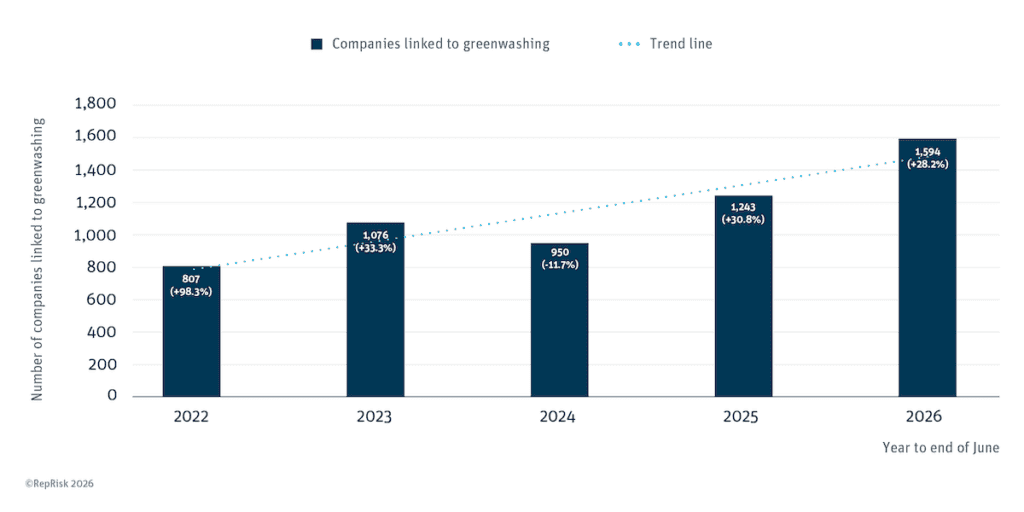
Findings reveal the number of companies linked to greenwashing rose for a second consecutive year, reaching 1,594 in the period to June 2026, up 28% year-on-year. This follows a 12% decline in 2024.
In just five years, greenwashing risk incidents have more than doubled overall, up a monster 112%.
Finance and banks in the frame
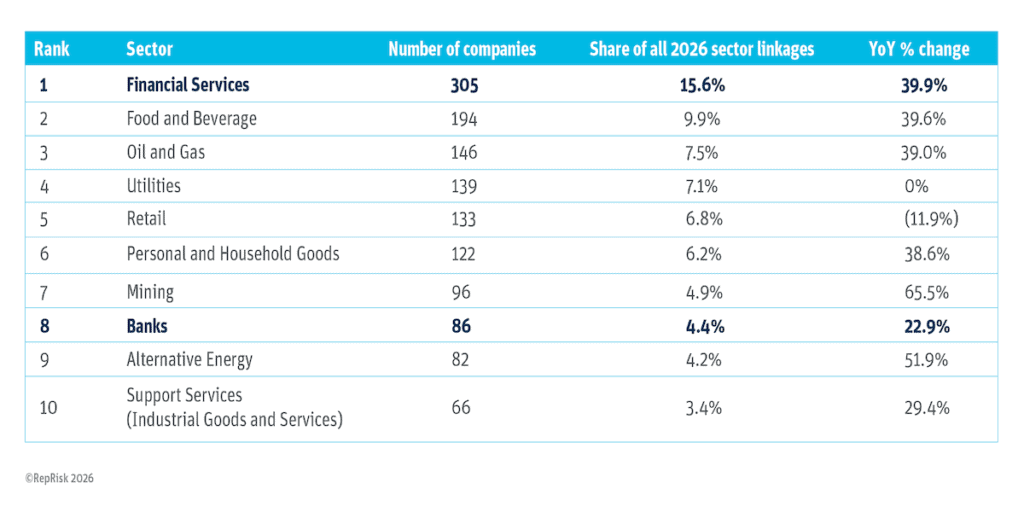
Top of the list of who to blame is the Financial Services sector, recording a massive year-on-year rise of almost 40% in the number of companies linked to greenwashing in 2026. Banks saw a surge too, of 23%.
Financial institutions sit at the center of this changing landscape. In 2026, Financial Services and Banks together accounted for one-fifth of all sector linkages among companies linked to greenwashing.
Financial Services ranked as the most exposed sector, with as many as 305 companies linked to greenwashing, while Banks rose to 86. For financial institutions, greenwashing risk can arise both from their own activities and from the companies and projects they finance, invest in, or underwrite.
Dirt on clean transition too
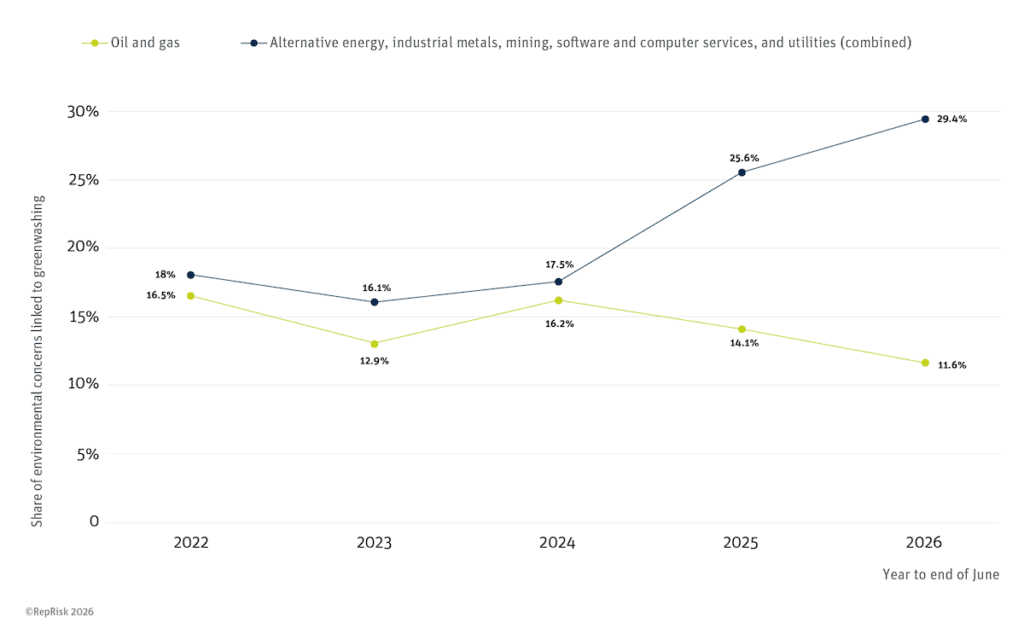
Interestingly, as the energy transition gathers pace, so too does the associated greenwash.
As a sectoral grouping, Alternative Energy, Industrial Metals, Mining, Software and Computer Services, and Utilities together accounted for 29% of greenwashing-related environmental issue linkages in 2026, up from 18% in 2022. By contrast, the share associated with Oil and Gas actually fell from 17% to 12%.
The transition to a low-carbon economy is creating a new greenwashing risk landscape.
So, as capital flows towards renewable energy, transition minerals, low-carbon infrastructure, and other climate solutions, scrutiny is increasingly extending beyond traditional high-emitting sectors to the activities intended to support the transition itself.
Money flows must be more data-dependent, says Philipp Aeby, CEO and Co-founder of RepRisk:
“The transition depends on informed capital allocation. As investments continue to accelerate, banks, asset managers, and asset owners must be able to cut through greenwashing.
“High-quality data that is relevant, accurate, and auditable enables financial institutions to identify emerging risks and ensure that capital supports credible transition efforts and long-term value creation.”
Biodiversity finally tops the agenda
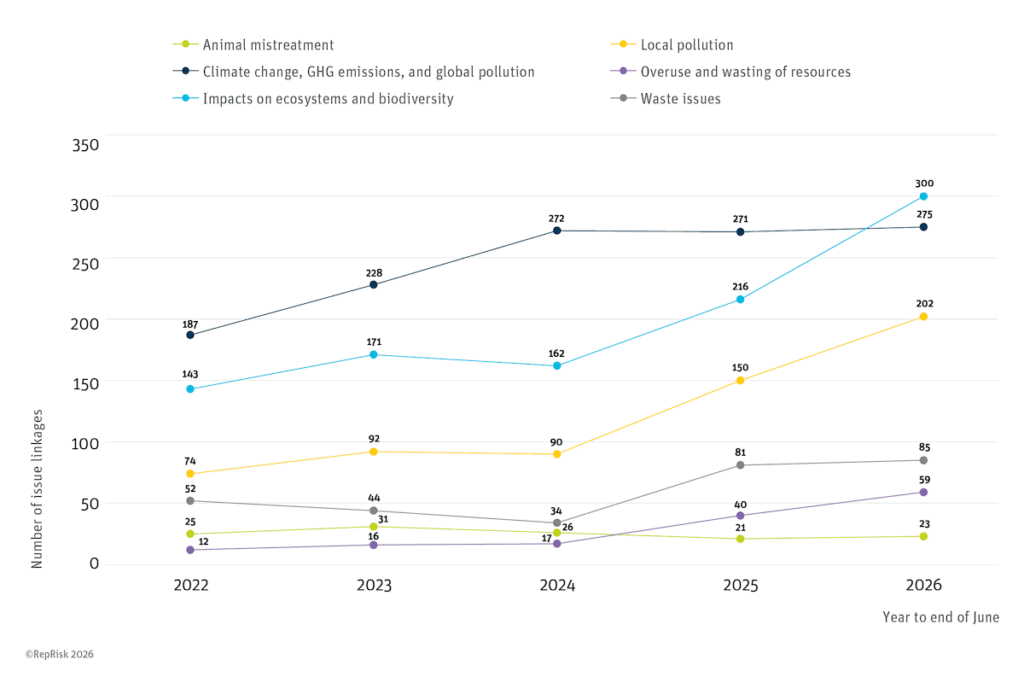
The environmental issues linked to greenwashing risk are also shifting.
Between 2024 and 2026, greenwashing linkages to ecosystems and biodiversity nearly doubled from 162 to 300, while those around climate change and emissions stayed broadly flat, edging up from 272 to 275.
As a result, biodiversity finally overtook climate in 2026, becoming the leading environmental issue linked to greenwashing risk for the first time in five years.
Omission, falsification and deception
RepRisk defines greenwashing as environment-related statements, communications, or actions that do not clearly and fairly reflect the environmental performance of an entity, product, or service.
Such communication may involve omitted, false, or deceptive information and may occur intentionally or unintentionally. Illuminating examples of greenwash covered in the report include:
- Clean power, wildlife risk: A proposed wind-power project was promoted as supporting clean energy and nature-positive outcomes. A conservation group challenged the claim, citing projected collision risks for protected birds. The case illustrates how a project may support decarbonisation while still raising serious questions about its potential impact on nature.
- Renewable fuel, incomplete records: A biomass power operator could not adequately substantiate parts of its reporting on the type and origin of the wood it used. A regulator required corrected data and a payment, while finding no evidence that renewable-electricity subsidies had been issued incorrectly. The question was whether the evidence behind the sustainability claim stood up, rather than whether the renewable label settled it.
- Battery mineral, contested footprint: A lithium producer positioned its operations as part of the clean-energy transition. Communities and campaigners challenged that narrative over alleged impacts involving water, mine waste, and neighboring communities. The example highlights that a mineral’s role in batteries does not answer how it was extracted.
- Clean cars, questions about drinking water: Reporting based on internal documents alleged that nickel mining and processing linked to electric-vehicle supply chains affected a nearby community’s water. The operator maintained the water was safe and later cited testing in support of that position. The end use of a transition mineral cannot substitute for evidence about conditions at the mine.
- A cleaner steel plant, but doubts about wider business: A steelmaker said that replacing coal-based production at one site would reduce emissions there. Unions questioned the broader picture as the company built another coal-based furnace overseas. A site-level reduction may be real without necessarily representing a company-wide result.
- Renewable purchasing, not round-the-clock clean power: A cloud provider matches annual electricity use with renewable-energy purchases, while explaining that individual data centres draw from local grids where power mix changes by the hour. This highlights a potential gap between annual accounting and physical consumption, rather than a greenwashing finding against the provider.
- A fossil-free promise without the specifics: An energy supplier stopped using a broad fossil-free claim after a regulator found that it did not explain what the company would do or allow consumers to compare its efforts with others. The regulator acknowledged that the company had a concrete emissions-reduction plan. The issue was the wording of the public claim, not the absence of a plan.
RepRisk is the world leader in DaaS for reputational risks and responsible business conduct. With its HQ in Zurich, plus offices in Toronto, New York, London, Berlin, Manila, and Tokyo, the company combines advanced AI with deep human expertise to help drive positive change through transparency.
Further Reading:
- More about the 2026 Greenwashing Report; published by Data-as-a-Service (DaaS) specialist RepRisk;
- Also on SustMeme, Authenticity: Are you green with envy, or suspicion?
- Also on SustMeme, Greenwashing and biodiversity risks now double (previous RepRisk report for 2025);
- Also on SustMeme, Rise in ESG risks linked to greenwashing;
- Also on SustMeme, Why credibility will define sustainable brand growth (Guest Blog);
- Also on SustMeme, Beyond the Label: Transparency not just taglines (Guest Blog);
- Also on SustMeme, ESG is not being taken seriously by companies;
- Also on SustMeme, Is greenwash the new goldrush for litigation?
Check out the full archive of stories on the SustMeme Business & Finance Channel, now available to Sponsor.