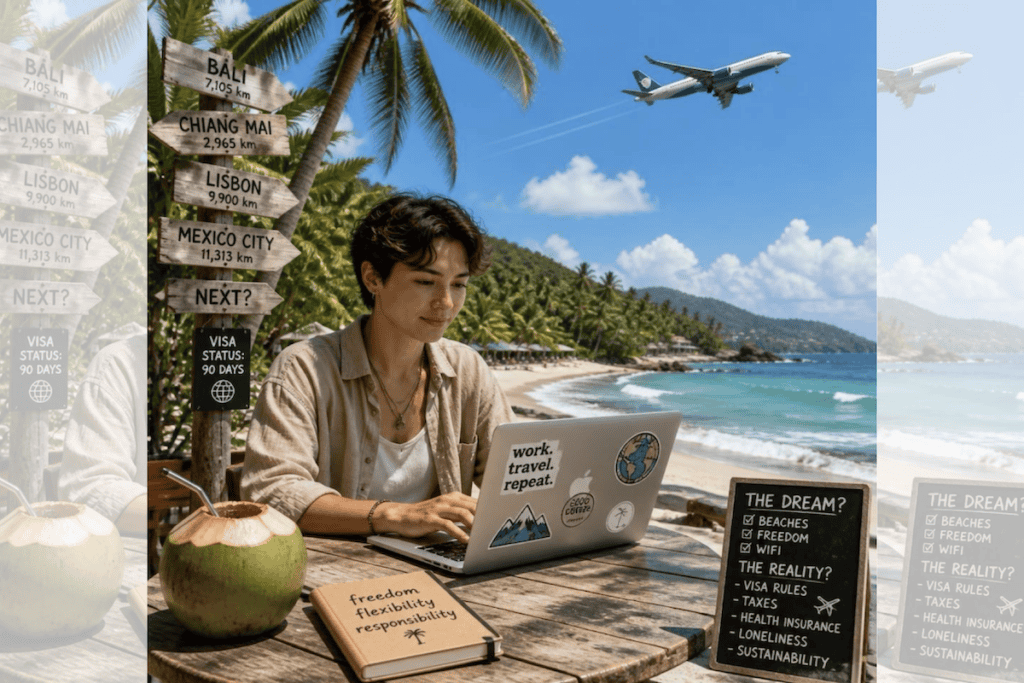
In this SustMeme Guest Post, health and travel writer Beth Rush draws on personal experience to explain the process, plus explore the pros and cons of taking remote working one big step further to become a full-blown digital nomad.
BR: Work from home (WFH) has already loosened the link between employment and geography. The more interesting question is what happens when ‘home’ becomes a country and not a spare bedroom.
The term ‘digital nomad’, first used back in 1993, is now listed in the Oxford English Dictionary and refers to:
“A person who uses digital technologies, esp. laptops, smartphones, and wireless internet access, to work remotely while travelling and living in a variety of different places.”
So how viable and sustainable is it to take remote working one step further and become a digital nomad?
Is remote work dying in 2026?
Well, remote work is less common than it was during the pandemic, but it is hardly disappearing. In the UK, for example, some 14% of people worked exclusively from home during the month of June 2026.
In general, hybrid working has become more popular than fully remote work, which suggests that flexibility is still valued even as office-based work returns.
If you want to take that flexibility abroad, though, your employment contract shouldn’t be the only thing you consider. Tax residency, employment law, insurance, data protection and time zones can all affect whether you are actually allowed to work from another country.
Where can you be a digital nomad?
You can work remotely from your own country, but digital nomad visas have made longer stays abroad increasingly accessible. A UN Tourism analysis of 54 destinations found that 47% offer visas lasting up to one year, plus 76% accept applications online and 80% even process them within a month.
In terms of support, there are also plenty of digital nomad discussions on the likes of Reddit, offering helpful insights and debating which countries offer the best combination of cost, lifestyle and infrastructure.
According to the Rumavi Global Relocation Index, the countries ranked among the top three choices for digital nomads in 2026 are Malaysia, Portugal and Thailand.
Personally, I chose Thailand for its tropical climate and its Destination Thailand Visa (DTV), which allows remote workers and freelancers to stay for up to five years with multiple entries. The application was entirely online, and while parts of the process were a little complex, it was pretty straightforward overall.
Realistically, who can make the leap?
The market for digital nomad jobs is more competitive than it was a few years ago.
In fact, recent statistics show that 87% of new job postings analysed in Q2 of 2026 were fully on-site, while hybrid positions accounted for 10% and remote work made up just 3%.
That makes getting a remote job with no experience increasingly difficult.
Digital nomadism may be more realistic for people already in location-independent work. Freelancers, contractors and business-owners tend to have more control over where and when they work. Younger workers and those approaching retirement may also have fewer commitments tying them to any one place.
Your budget is just as important. A country with a lower cost of living can make the lifestyle more affordable, but you still need to account for the likes of groceries, healthcare, accommodation and visa fees.
Is digital nomadism sustainable?
The good news is that working remotely is obviously likely to eliminate the daily commute.
The not-so-good news is that frequent flights and other impacts associated with short-term fast-turnaround accommodation can quickly cancel out some of those initial gains. Air travel alone accounts for 2.5% of global carbon dioxide emissions and around 4% of the warming attributable to human activity.
So, digital nomads keen to show environmental awareness and pursue more sustainable lifestyles may soon find themselves facing something of a dilemma.
Research points to a paradox, as individual aspirations and efforts around sustainability can prove difficult to achieve and maintain when long-haul travel, local economic pressures and gaps in regulation are involved.
Overall, staying longer in one place and travelling less often help make the lifestyle more sustainable.
Can working somewhere beautiful prevent burnout?
As regards health and wellbeing, a change of surroundings can genuinely make working life feel easier.
Sometimes, just getting away from the office can help. One survey found that 61% of people felt more productive working from home; plus 34% reported remote productivity being equal to that achieved on-site.
I noticed this myself in Bali. When work became stressful, I could easily close my laptop and watch the sunset at Batu Bolong Beach, or walk through the greenery around Ubud.
That time in nature was more than a nice break, as research shows walking in a forest can calm the amygdala, the part of the brain involved in processing stress.
However, the benefits don’t mean a tropical backdrop is a cure for burnout.
I spent around two years as a digital nomad, and deadlines still followed me across borders. The real advantage was having more opportunities to step away, reset and return to work with a clearer head.
Freedom has a postcode problem
At the outset, searching for digital nomad jobs can make the whole scenario look deceptively easy.
Finding, getting, or keeping the job itself is only part of the decision, though. There is a lot left to consider, even for those lucky enough personally and professionally to have the choice.
Ultimately, if the practicalities work for you, taking WFH abroad can offer genuine freedom and still leave room for sustainability and wellbeing.

Beth Rush is a freelance writer specialising in how sustainable travel and time spent in nature impact mental health and planetary wellness. Having Attention-Deficit/Hyperactivity Disorder (ADHD), Beth brings a neurodivergent lens to eco-travel writing. Widely published in medical journals and on health platforms, she is also an AFPA Certified Autoimmune Holistic Nutrition Specialist.
Further Reading:
- Also on SustMeme, How regenerative tourism can become a green swan;
- Also on SustMeme, Leisure and tourism must race to revive our oceans;
- Also on SustMeme, Travel Sustainable badge for property stays worldwide;
- Also on SustMeme, Jet fuel from waste plastic brings clean air travel step closer;
- Also on SustMeme, Seawater harvesting for island hotspot in Baltic Sea;
- Also on SustMeme, Cultural Tourism: Prodigy, or problem child? (2014)
You can check out the full archive of past Guest Blog posts here.
Would you like to Guest Blog for SustMeme? For more info, click here.
SUSTMEME: Get the Susty Story Straight!