In this SustMeme Guest Post, Zach Smith, Founder of NevadaSolarGuide.com discusses climate resilience in the built environment, and how a vulnerability audit can help harden critical real estate against cascade failures in extreme heat.
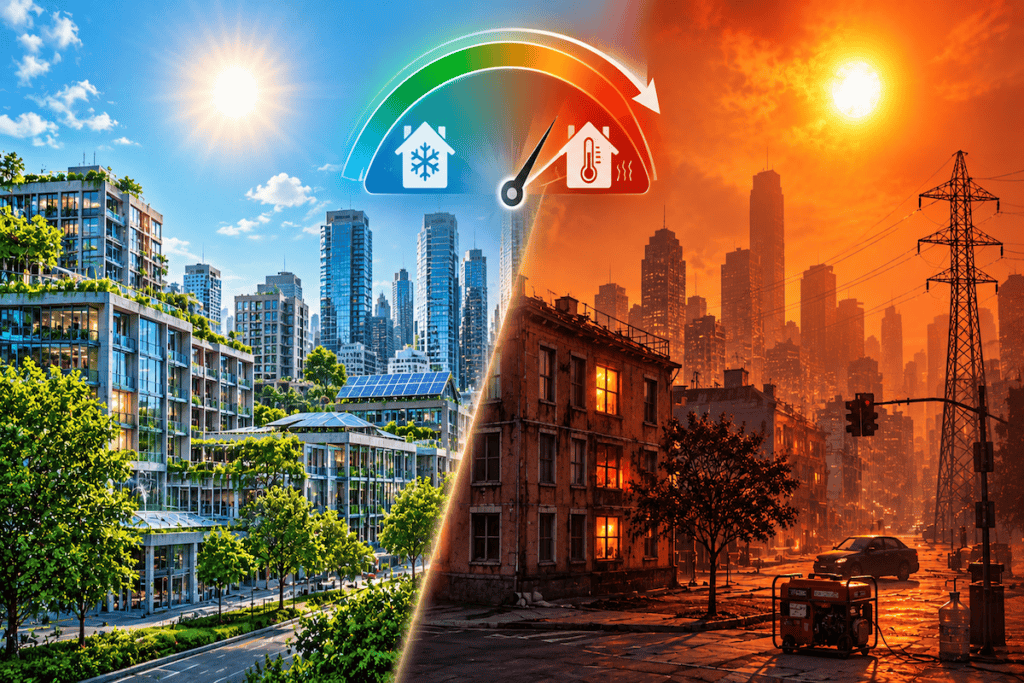
ZS: Intensifying urban heat islands and multi-day heatwaves exceeding 110 °F are exposing a critical vulnerability in modern construction: the near-total dependence of buildings on centralised, grid-tied power.
High-performance buildings optimised for energy efficiency under normal conditions soon become sealed thermal traps once a blackout/brownout disables HVAC, mechanical ventilation, and domestic water pumps.
For urban planners, asset managers, and climate adaptation engineers, the priority is therefore shifting away from merely maximising efficiency under normal grid conditions.
Instead, they now need to conduct vulnerability assessments that treat extended grid loss as a baseline design scenario rather than a rare contingency.
Urban heat island effect
Urban heat islands elevate city temperatures several degrees above surrounding rural areas, as concrete, asphalt, and dark rooftops absorb solar radiation throughout the day only to re-radiate it after sunset.
As a result, when multi-day heatwaves coincide with peak air-conditioning demand, regional grids are driven to their limits, producing voltage sags and full blackouts. The consequences can be life-threatening.
Modelling of concurrent heatwaves and multi-day grid failures in major US cities indicates that heat-related mortality can more than double under these conditions. Given the limitations of current infrastructure, a substantial share of a city such as Phoenix, Arizona, could potentially be left requiring medical care.
This is how dependence on centralised building systems turns a grid failure into a cascading life-safety event.
Damage, overheating and failure
Even before a complete blackout, prolonged brownouts can damage equipment.
As voltage declines, electric motors draw higher current to maintain torque. This can lead to incidences of overheating and failing HVAC compressors and sensitive electronics.
Once utility power is lost, chillers, air-handling units, elevators, and mechanical ventilation stop operating, and domestic water and fire-suppression booster pumps lose pressure.
The same features that improve energy efficiency under normal conditions – tightly sealed, heavily insulated envelopes – then work against occupants by trapping residual heat and internal loads.
As a consequence, indoor temperatures can reach dangerous levels within a matter of hours.
Standards not built for this
Standard building codes have not yet fully addressed the combined risks of extreme heat and extended grid failure. Historically, energy codes have focused on annual energy efficiency and peak-load reduction under the assumption of continuous, reliable utility power.
Updated standards such as the 2021 International Energy Conservation Code (IECC) improve passive survivability. In fact, National Laboratories modelling indicates that stronger building envelopes can extend safe shelter-in-place durations by roughly 140% and reduce extreme-heat mortality by up to 80%.
Nevertheless, most adopted codes still do not require multi-day thermal resilience, operable natural ventilation paths, or dedicated backup power for critical life-safety loads.
As a consequence, high-performance buildings designed primarily for efficiency can underperform during a grid outage. Their tightly sealed envelopes and fixed, non-operable windows eliminate passive cross-ventilation and night-flush cooling once mechanical systems shut down.
So what can be done to ensure climate resilience gets built-in to help protect portfolios, and save lives.
How to harden for self-reliance
Effective heat-and-grid hardening depends on three integrated strategies rather than any single measure:
- First, localised microgrids that combine rooftop or canopy solar with stationary battery storage enable critical loads – minimum ventilation, designated cooling refuge zones, and domestic water pumping – to island seamlessly from a failing utility grid.
- Second, passive thermal envelope improvements reduce the cooling load that backup power must support – so, high-albedo cool roofs and cladding, exterior solar shading, continuous insulation with minimised thermal bridging, and controlled night-flush ventilation all slow indoor heat accumulation.
- Third, autonomous backup generation – whether diesel, natural gas, or fuel cells, sized for essential circuits and equipped with automatic transfer – provides multi-day capacity when solar generation and battery reserves are insufficient.
Together, these layers convert a grid-dependent building into a self-reliant facility capable of maintaining safe, habitable conditions for days rather than hours.
Stress-test portfolios for resilience
Going forward then, asset managers and engineers should institutionalise vulnerability audits that stress-test building portfolios against heatwaves of 110 °F or higher lasting 48 to 72 hours. These assessments should include both voltage-sag brownouts and full grid blackouts.
At policy level, urban planners can accelerate this transition by including passive-survivability benchmarks and microgrid-readiness requirements in local zoning overlays and green-building incentive programmes.
The reality is that extreme heat is already driving centralised urban power grids beyond their design limits.
So, when the next cascading grid failure occurs, the buildings that remain safe, habitable, and operational will be those engineered from the outset to function without continuous utility power.

Zach Smith is the founder of NevadaSolarGuide.com, a consumer guide to solar and storage for Nevada homeowners. Living in North Las Vegas himself, Zach got tired of generic solar advice that failed to account for extreme desert heat, dust storms, or intense sun. So, after researching, installing, and testing solar systems in real Nevada conditions, Zach decided to create the guide as a practical, no-hype resource for local homeowners, campers, and ‘preppers’. His goal is simple: To help fellow Nevada residents install the right system, maximise their savings, and avoid expensive mistakes.
Further Reading:
- More about the NevadaSolarGuide.com;
- Also on SustMeme, Heat of the night: How bad sleep hits hard at work;
- Also on SustMeme, How energy codes power industrial green building;
- Also on SustMeme, Microgrids fuel guilt-free holiday-season resilience;
- Also on SustMeme, Urban regeneration designed for climate resilience;
- Also on SustMeme, Machine learning helps map solar and green roofs;
- Also on SustMeme, UK & Irish homes are coolest in Europe;
- Also on SustMeme, Building for climate resilience – from cold snap, to heatwave (2018).
You can check out the full archive of past Guest Blog posts here.
Would you like to Guest Blog for SustMeme? For more info, click here.
SUSTMEME: Get the Susty Story Straight!