
New Writing: As President Trump takes aim at emissions in his deregulation firefight, Jim McClelland asks: To counter the uprising in climate scepticism, do we just need to follow the money?
Climate sceptics must be feeling pretty pleased with how 2026 has panned out so far.
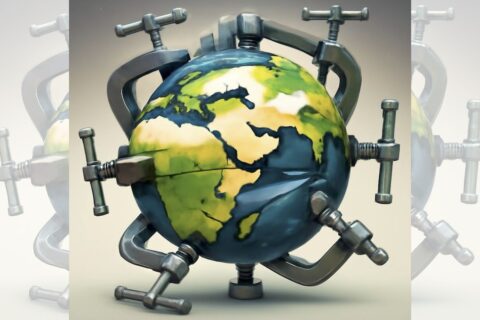
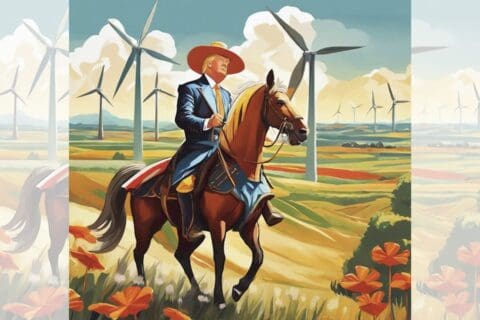
Their Denier-in-Chief, the 47th President of the United States, has come out both barrels blazing, taking aim at climate policy and emissions regulation, firing seemingly at will.
Climate in the crosshairs
On February 12, 2026, at the behest of President Trump, the US Environmental Protection Agency (EPA) officially repealed key elements of its legislation of greenhouse gases from 2009 known as the ‘endangerment’ and ‘cause or contribute’ findings.
Forming part of the US Clean Air Act (CAA), these findings cemented the foundational link between GHGs and public health, so providing a legal basis for regulation of emissions.
The knock-on effects will impact climate regulation of emissions from a whole host of sectors and markets, including power plants, buildings and, most significantly, transport.
The Trump administration is billing this roll-back as part of the ‘biggest regulatory relief’ in history — but push-back has been immediate and widespread, involving multiple parties.
The lawsuits have already begun, with a broad coalition of health and environment groups suing the EPA within days of the announcement of the rescission of the findings.
SCOTUS vs POTUS
As if a bonfire of the regs were not enough, all this disruption takes place at a time when crude oil prices are dancing merrily up and down on traders’ screens in knee-jerk response to news and rumour of US military manoeuvres against the likes of Venezuela and Iran.
Plus, just when import-export sectors thought it safe to reset prices, tariffs got torn up, too.
On the Friday February 20, the Supreme Court of the United States (SCOTUS) voted to throw out the blanket tariffs originally imposed on imports by the President of the United States (POTUS) back on so-called ‘Liberation Day’, sparking calls and claims for refunds.
That same day, however, the President retaliated, invoking authority under a 1974 Trade Act to levy import duty at 10% as standard, at least temporarily for a period of 150 days.
Then, less than 24 hours later, he summarily raised the bar to 15%. This major uplift was announced merely in a post made by the President on his own media site Truth Social.
When it comes to geopolitics, global trade, economics and the stock market, it seems the only thing certain is volatility. So where does this leave sustainability in business?
Divestment hits hard
Interestingly, signals from the investment community around sustainability nevertheless remain largely positive. If you are in need of some reassurance, just follow the money.
In particular, pay close attention to where it is not going — track the divestment narrative.
Reneging on sustainability principles and promises is proving costly — divestment hits where it hurts.
Last December, for example, Dutch activists successfully pushed pension fund PME to pull $5.9 billion from Blackrock, the largest asset manager in the world. Barely three months earlier, another major Dutch pension fund, PFZW, had already withdrawn a whopping $16.98 billion from the same manager.
The main reason given for its big-money move away was a lack of alignment on sustainability issues.
Crucially, this upbeat high-level investment play is also finding expression increasingly far out along the the supply chain. In short, for sustainability, the diversification trade is on.
Trade the transition
At present, diversification typically get talked about most in respect of the eye-watering amounts of precious capital being sunk deep into artificial intelligence (AI).
Now, as the stratospheric early-riser stocks either start to slow or stumble, traders turn to look beyond prime movers such as Nvidia, or OpenAI, or data-centre-heavy hyperscalers and behemoths of the cloud like AWS (Amazon), Alphabet (Google) or Microsoft (Azure).
In a bid to manage risk but maintain growth, the market is shifting its focus to beneficiaries of the tech revolution, seeking out sectors and companies actually profiting from AI usage.
The same investment approach is arguably now emerging in the global energy transition.
Ripples into real estate
The ripples of the energy transition continue to spread out far and wide across different sectors and markets, way beyond climate finance, power generation, utilities and grids.
Take office property and commercial real estate, for example. Energy and running costs aside, why would a commercial landlord risk capital in a somewhat tepid property scene to invest in a substantial building upgrade to remove gas heating and install heat pumps?
The answer, in their own words, is they need to up their credentials around carbon emissions, energy efficiency and social governance to win and keep the calibre of corporate client they want and need.
In practice, an Environmental Performance Certificate (EPC) with a rating of ‘B’ or above therefore becomes an essential asset in a competitive current and future market.
This is the business case for sustainability; and this is also diversification in action.
Picks and shovels
In an era of climate goldrush, where decarbonisation is global gold, then tried-and-tested technologies, resources, products and materials — such as green energy and heat pumps — are the picks and shovels.
Change is happening; and it is happening right now in the real world of budgets and deliverables, miles away from the White House, in places like Manchester, England.
The climate fight is on; and it is on-site. Don’t despair. Keep the faith and follow the money.
To read more, check out the fuller-length version of this article, free to access and view on The Hub:
Is global finance ready to trump climate scepticism?
To view a back-catalogue of articles authored by Jim McClelland for ‘The Hub’, please see archive here.
SUSTMEME: Get the Susty Story Straight!