
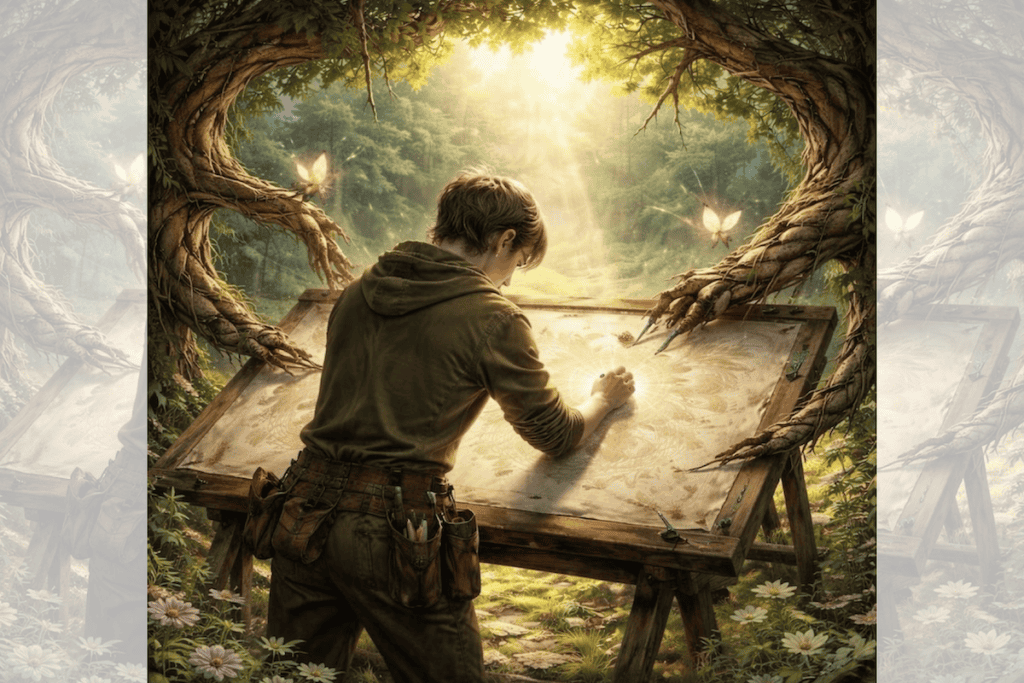
In this SustMeme Guest Post, James Addison, Creative Director at forpeople, challenges designers to work with nature and embrace biomimicry as an integral part of their creative process, rather than just to apply a little green gloss.
JA: Nature appears everywhere in design. From leaf motifs through to earthy palettes, while earnest slogans become shorthand for green credentials and sustainability. Appearances, however, can be deceiving.
Unfortunately, we are adept at making things look natural yet seldom ask what nature actually does.
Instead, imagine treating a forest as a collaborator, rather than just a moodboard…
How you design with living systems could change both the creative process and the way brands communicate sustainability. As a result, we find ourselves less and less interested in simply making something look as if it’s from the natural world, and more interested in understanding what that world might actually teach us, as designers.
Nature has so much it can teach us – not just about design itself, but systems and human experience, too.
Letting go of control
So, what if we let nature become the designer?
This was an insight that began during a pitch from our design studio for a coastal retreat. The design brief to us promised no trees would be moved and no terrain bulldozed. We asked the question around what would happen if, rather than impose an emblem on that landscape, the trees could draw or the sea could paint?
Admittedly, it does sound slightly far-fetched, when written down.
However, with a pragmatic approach, we tied pencils to swaying branches and let the wind trace lines across paper. We placed cyanotype papers in tidal pools and allowed waves and splashes to expose fluid, unpredictable patterns. Those marks, shaped by the place, became the building blocks of an identity.
That project was never realised, but the exercise shifted our thinking. It showed that when we step aside, the environment can shape the work, and the designer’s role becomes that of facilitator rather than author.
Nature responds, adapts and evolves. Brand systems can do the same.
Beyond the aesthetic
What if we let ourselves learn from how nature behaves?
Designing with nature, and its influences, can happen at different depths.
Sometimes it is literal and collaborative. Other times it’s about observing behaviours, rhythms or emotional cues and translating those into design language.
So, when we led an electric‑car project from NIO where the car was designed to be small, electric and buzzing with energy, we drew inspiration from the world of fireflies. We employed neon glows and sweeping letterforms to echo the insect’s light patterns. The tone of voice pulsed in short, staccato sentences.
Our work for Tree Aid took a deeper step. We began by taking bark rubbings and photographing leaves and seeds in the African landscapes where the charity operates. These became tactile textures for the brand.
Then we placed sensors on living trees and translated their bio‑electrical signals into subtle movement, allowing visuals to shift and breathe. Instead of portraying trees, we let them contribute to the brand.
This approach revealed the fundamental difference between representing nature and responding to it; between using nature as a motif and letting its rhythms shape an identity.
Forest as ecosystem
This perspective of working with nature on a brand project leads designers to ‘systems thinking’.
A single tree cannot survive on its own. Forests are communal, interdependent networks.
Older ‘mother’ trees can support younger saplings by sharing nutrients and information via mycorrhizal networks – fungal networks that form a ‘wood‑wide web’ and carry water, carbon and chemical signals between trees. These underground worlds favour cooperation and reciprocity over fierce competition.
In principle, biomimicry can enlighten us and encourage us to think more in natural loops.
In practice, for a business, that kind of thinking could mean integrating products and brands into regenerative cycles so that materials and energy flow without harm.
Brands can also learn to behave more like those adaptive and mutually supportive ecosystems
In such a system you would hope that sustainability would become less a marketing message and more a living practice. It could also mean creating supply chains that actively share resources, insights and information, while inviting users to help shape the brand.
Design for how people feel
There is also a sensory dimension to designing with nature – which is becoming increasingly important, sadly for all the wrong reasons. The issue is that whilst we as humans have evolved successfully for centuries surrounded by light and air, plants and animals, we now perversely spend most of our time indoors.
Neuroscience and neuroarchitecture has consistently shown that those environments that are rich and heavy in natural cues (think dappled light, organic textures, gentle soundscapes) lower heart rates and the hormones that cause stress. It has also been shown that these natural environments can accelerate healing.
This matters in spaces such as airports and offices where tensions can run high and design often favours efficiency. Imagine walking along office corridors which are aligned to circadian rhythms, while using materials that soften acoustics or invite touch, or natural forms that create a sense of refuge.
Designing when thinking about and acting with living systems is not, however, about turning an international airport terminal into an Amazonian rainforest. Rather, it is about articulating and presenting something that acknowledges the natural environments that our nervous systems are calibrated towards.
It is about creating spaces that feel restorative and promote calm.
Sustainability and brand stewardship
So, where does all this leave branding?
Branding is bound to an attention economy that rewards novelty and visibility. As a result, the relationship between brand and sustainability often runs the risk of merely applying a green gloss on a business model.
However, a more radical vision might treat brands themselves as living systems that are able to adapt and invite participation and demonstrate values.
Therefore, instead of megaphoning a fixed green narrative, what if a brand could open up genuine and authentic channels to customers and stakeholders for exchanging ideas and challenges, allowing people and communities to influence its expression and its story?
In that world, designers would become stewards of evolving ecosystems rather than creators of guidelines that too often feel rigid. The role of the designer would not be to invent a sustainable look; instead, it would be to help people experience their place within a larger web of relationships. In other words, think forest…
Forests have evolved to communicate clarity, balance and deep interdependence. If we can truly learn from the millions of years of their sustainable R&D, then that understanding may ultimately help us rediscover the purpose of design and our place within the natural world.
James Addison is a Creative Director at forpeople, a multidisciplinary studio based in London and Amsterdam. With over 15 years of consultancy experience, he synthesises strategy, branding and design for organisations globally.
James leads on key sustainability initiatives, driving transformative branding and innovation for the likes of Tree Aid, Nio’s latest EV brand Firefly, The Body Shop and Six Senses.
Further Reading:
- More about forpeople, the multidisciplinary studio in London and Amsterdam;
- Also on SustMeme, Bank on wood for touch of premium sustainability;
- Also on SustMeme, Greenwashing and biodiversity risks now double;
- Also on SustMeme, Sustainability report gets voiced in Gen-Z fashion;
- Also on SustMeme, Why credibility will define sustainable brand growth;
- Also on SustMeme, Beyond the Label: Transparency not just taglines.
You can check out the full archive of past Guest Blog posts here.
Would you like to Guest Blog for SustMeme? For more info, click here.
SUSTMEME: Get the Susty Story Straight!