
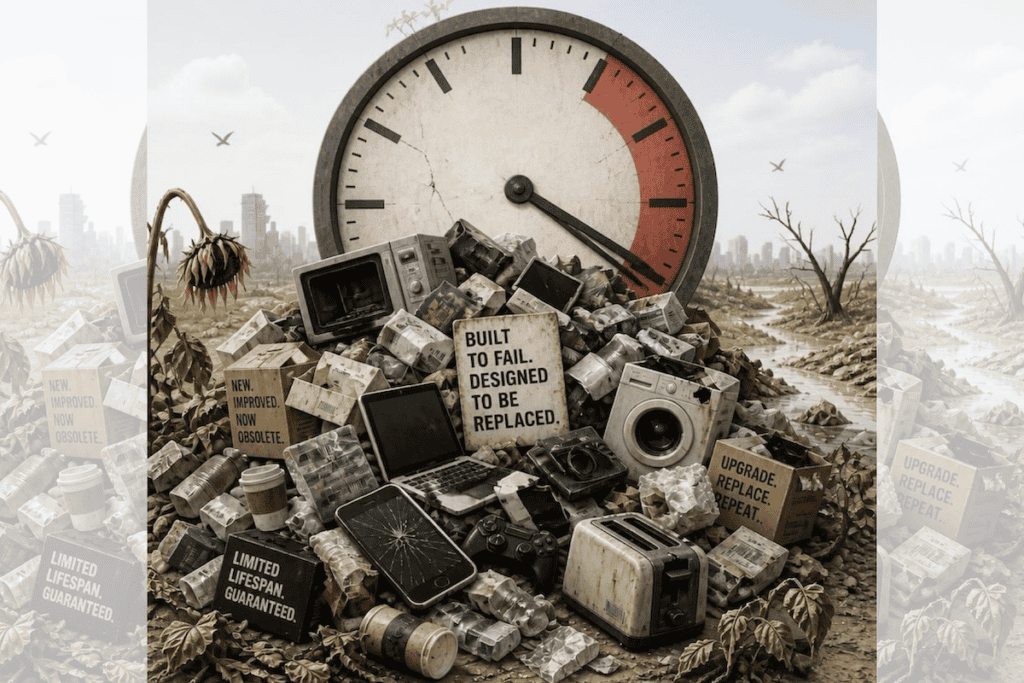
In this SustMeme Guest Post, Jane Marsh, Editor-in-Chief at Environment.co, unpicks the business models, marketing ploys and consumer trends that underpin the ongoing popularity of unsustainable products seemingly designed to fail.
JM: Modern consumers expect convenience, affordability and the latest features, but those expectations often come with a hidden cost. Across many industries, product design for manufacturing has increasingly prioritised speed, lower production costs and recurring sales over long-term durability.
While not every manufacturer intentionally designs products to fail prematurely, economic incentives often encourage a shorter product lifecycle, which boosts revenue while contributing to growing waste streams.
So, are products deliberately built to fail? And are consumers complicit in this eco crime?
Shift to shorter lifecycles
For manufacturers, reducing production costs is key to remaining competitive. This often leads to using cheaper materials or designing products with deliberately shortened lifespans to improve profit margins.
These strategies allow businesses to offer attractive price points, but can also cut product longevity. In fast-moving industries such as electronics, furniture, fashion and household appliances, products are often replaced long before they are physically worn out as newer models or styles soon become available.
This move towards planned obsolescence mark a significant shift away from aims in previous generations, when furniture, appliances and household goods were built with repairability and longevity in mind.
Back then, a preponderance of solid wood furniture, mechanical appliances and replaceable components typically made repairs relatively straightforward and cost-effective. Consumers commonly maintained, refurbished and passed down products from generation to generation.
Today, many products rely on composite materials, glued assemblies or proprietary components, making repairs difficult or economically unviable. At best, such unsustainable designs drive the trade-in merry-go-round ever faster, consuming resources inefficiently; at worst, they feed a throwaway culture.
Manufacturers are not the only party at fault, however – marketers and consumers are in the frame, too.
Demand for the disposable
Consumer demand plays a major role in the shortened lifecycle of many products. When budgets are limited, buyers often prioritise affordability and immediate needs over long-term durability. A lower-cost product that only lasts a few years can seem like a more practical choice than a higher-priced alternative.
Marketing strategies and frequent product updates also encourage replacement.
In industries such as electronics, fashion and homewares, consumers are often influenced by new features, changing styles and social trends – they get actively pushed and pulled in the direction of a tech upgrade, a wardrobe refresh, or a room makeover.
Online shopping and digital advertising make it easier than ever to replace items quickly rather than repair or maintain them. This creates a cycle in which manufacturers continue to produce lower-cost products to meet consumer expectations, while buyers become accustomed to frequent replacements or upgrades.
Environmental cost of poor design
The consequences of this retail death spiral extend far beyond individual households.
Products with shorter lifespans generate enormous amounts of waste. While recycling programmes exist, many manufactured goods are challenging to recycle because they combine plastics, metals, adhesives and electronic components into complex assemblies.
Separating these materials requires specialised equipment and labour, making recycling expensive. As a result, recycling levels in the likes of the UK remain low, at only 43.8% in 2024, down from 44.0% in 2023.
One example of low-price products with hidden costs would be poor-quality LED bulbs, which may have weak drivers, cheap soldering and minimal heat management, shrinking their effective lifespan.
The end-of-life impacts add up fast. Significant quantities of discarded products are destined to get sent to landfills or exported to developing countries as electronic waste, incurring social and environmental costs.
Communities in lower-income regions often bear the environmental and health impacts of dismantling or processing these products under unsafe conditions.
Hazardous materials contaminate soil and water supplies, while informal recycling operations expose workers to toxic substances without adequate protection.
Economic impact across industries
Although manufacturers may benefit from increased replacement purchases, frequent product turnover can reduce production efficiency while weakening brand reputation and long-term customer value.
Adopting circular economy and circular design principles brings multiple potential economic benefits, not just environmental and social. Designing products for durability, repair, reuse and recycling can help businesses recover more value from materials, reduce waste and improve resource efficiency.
In fact, wasteful patterns of production and consumption under today’s linear economy result in an estimated €25.4 trillion in economic value lost globally each year. Greater than the gross domestic product (GDP) of any country in the world bar the United States, the sheer size of this number highlights the significant financial opportunity of more circular business models.
So why do we persist with products designed to fail?
Learning to love long-term value
Well, the appeal of disposable products remains strong because it aligns with both business objectives and consumer purchasing behaviour. Manufacturers gain repeat customers, while consumers enjoy lower up-front prices and access to the latest designs.
However, this relationship often overlooks the hidden long-term costs, including more frequent replacements, increased household spending, greater environmental damage and more pressure on global waste management systems.
Improving this cycle requires collaboration across industries and consideration of the waste hierarchy – a system that ranks waste management options by their environmental impact.
Manufacturers can select durable materials, design products to be repaired and make replacement parts readily available. Businesses can also invest in modular designs that extend product life while maintaining profitability through service, maintenance and upgrades rather than replacement alone.
Meanwhile, consumers themselves can influence the market through purchasing decisions.
The growing demand for repairable, longer-lasting products is encouraging manufacturers to reconsider traditional business models. For example, Repair Cafés are becoming increasingly popular in countries like the Netherlands and UK. Primarily staffed by volunteers, these local hubs help communities keep things out of landfills, repair possessions and prevent CO2 emissions caused by throwing away and buying new.
Flip the script on failure
For good or bad, the lifecycle of modern products ultimately reflects the complex relationship between manufacturing costs and consumer expectations. So, while affordable products may provide accessibility, their shorter lifespans can create economic and environmental challenges.
It is possible to flip the script, however. In prioritising durability, repairability and responsible product design, manufacturers can actually create greater long-term value for businesses and consumers.
In this way, manufacturers strengthen their competitive position and contribute to a more sustainable economy that benefits consumers, businesses and communities worldwide.

Jane Marsh is Editor-in-Chief of Environment.co, where she leads the publication’s mission to make sustainability accessible and actionable for readers worldwide. With a background in environmental journalism and communications, Jane has spent her career exploring the intersection of technology, policy, and sustainable living. Jane is passionate about advancing awareness around clean energy transitions, circular economy practices, and the future of green infrastructure. Under her editorial direction, Environment.co continues to highlight the people and tech driving a more sustainable planet.
Further Reading:
- More about features and news on Environment.co;
- Also on SustMeme, True cost of IT: E-waste hidden in plain sight;
- Also on SustMeme, Upcycling at scale is not only possible, but powerful;
- Also on SustMeme, Resale is a step up for sustainability in fashion;
- Also on SustMeme, Gaps in key sustainability data from manufacturers;
- Also on SustMeme, Pollution on rise as only 9% plastic waste recycled;
- Also on SustMeme, How can we close the global Circularity Gap?
- Also on SustMeme (by Jane Marsh), Does outsourcing add up for construction waste?
- Also on SustMeme (by Jane Marsh), Why is it still so hard to recycle rare earth metals?
You can check out the full archive of past Guest Blog posts here.
Would you like to Guest Blog for SustMeme? For more info, click here.
SUSTMEME: Get the Susty Story Straight!