
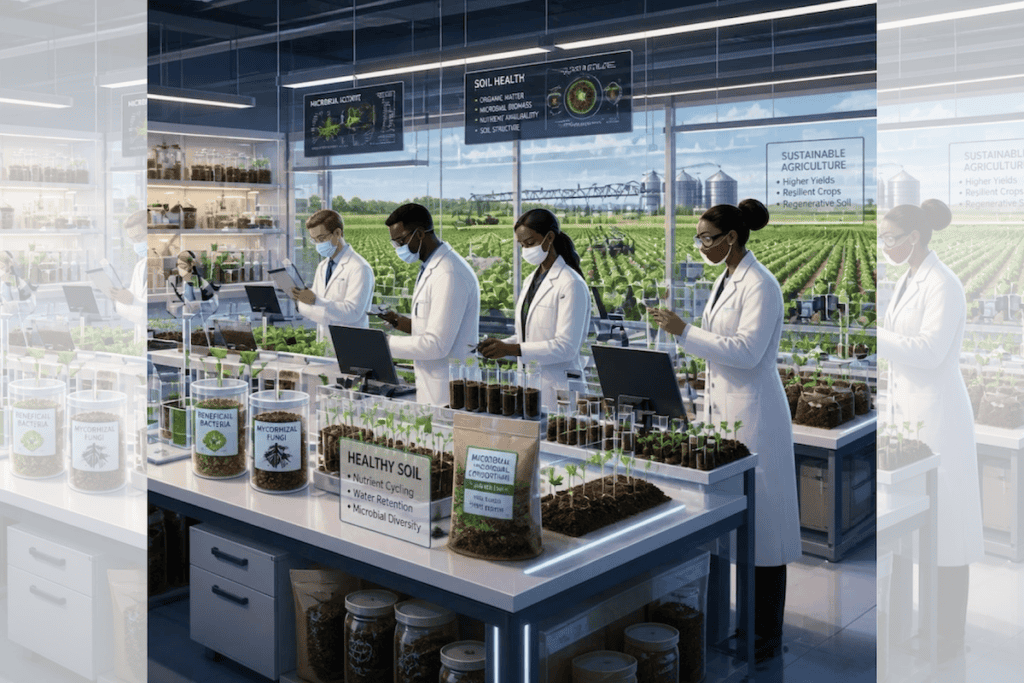
In this SustMeme Guest Post, Grace Waters, Senior Editor at Environment.co, urges biotech to copy the infrastructure playbook and submit its new generation of soil products to rigorous testing in the lab prior to deployment in the field.
GW: The biotech industry has unlocked a new generation of soil amendments promising to replace synthetic inputs with living microbial formulations. These biologicals are marketed as sustainable alternatives that improve soil health without the environmental footprint of traditional fertilisers.
The thing is, though, biological amendments contain living organisms – and the behaviour of such organisms can shift unpredictably across different soil environments.
So, without engineering-grade validation protocols to confirm real-world performance before commercial deployment, these products effectively represent an uncontrolled experiment at field scale.
Hidden risks of unverified additions
Biological soil amendments differ fundamentally from synthetic fertilisers. Synthetic products generally offer more consistent chemical composition than biological formulations.
Biological formulations, by contrast, contain living microorganisms whose activity depends entirely on the environment they encounter. Soil type, climate, moisture availability and the resident microbial community all influence whether an introduced organism thrives, becomes dormant or dies outright.
This variability creates significant agronomic risk. A biological product that performs well in one soil profile may behave unpredictably or fail in another, without controlled trials to detect inconsistencies beforehand.
Unpredictable performance exposed
Poor or unpredictable performance carries clear potential cost implications. Growers typically apply biological amendments as supplemental inputs on top of their standard fertility programmes. This means an underperforming product represents a direct financial loss rather than a neutral outcome.
According to specialists in soil microbial analysis at BIOTREX, it is therefore imperative that microbial inoculants and biostimulants function within existing soil communities. This is where baseline microbial activity, competition and field-specific biology can shape whether a product produces a measurable result.
Results are not always positive. Instances of variability or inconsistency can show up in on-farm evaluations of commercial biological products, where promotional claims get put to the test and frequently fall short.
One such independent field trial examined a widely marketed compost tea product. The research findings, as published by Practical Farmers of Iowa, concluded that it “didn’t live up to its promotional advertising”.
Unfortunately, this unsuccessful outcome is precisely the kind of questionable performance that reinforces concerns about the reliability of biologicals deployed without rigorous validation.
Learning lessons from infrastructure
The solution to the problem, however, lies close at hand. The agricultural sector can address its reliability gap by adopting the same validation rigour that infrastructure engineering has applied for decades.
In high-stakes engineering environments, materials are never deployed at scale until their real-world behaviour has been confirmed. Many infrastructure materials must be evaluated through controlled testing, field observation and long-term performance monitoring before they are approved or widely adopted.
The same three-part validation framework applies directly to biological soil amendments. A growing body of applied research reflects this shift toward systematic evaluation, including reviews of biochar field trials that assess soil health effects, field performance and the need for long-term validation before large-scale use.
That same validation mindset also appears in environmental assessment contexts.
For example, EHS consultant TRC has undertaken bench-scale PFAS soil research to demonstrate how controlled testing can clarify chemical behaviour before large-scale environmental decisions are made.
In this pioneering research work, TRC states that it documented “the first time the complete transformation of 6:2 FTS to PFHpA has been observed” under ambient surface water-like conditions.
Although the study focuses on PFAS soil behaviour rather than agricultural amendments, it reflects the same engineering-grade validation principle: namely, that controlled conditions, measurable reactions and repeatable performance data should come before broad environmental deployment.
What is engineering-grade validation?
Engineering-grade validation of soil amendments rests on two complementary pillars of testing that together confirm both chemical behaviour and ecological impact before field deployment.
- Bench-Scale Matrix Testing: Bench-scale testing isolates interactions between a biological amendment and soil under controlled laboratory conditions. Just as environmental engineers test how contaminants behave in different soil types, agricultural scientists must use predictive models to assess how biological formulations perform in synthetic and native soil matrices before they are introduced into open fields.
Controlled lab environments allow researchers to isolate critical variables such as moisture content, pH balance and soil texture, revealing how an amendment performs when external factors are held constant.
This isolation is essential because field environments introduce dozens of interacting variables simultaneously, making it nearly impossible to determine why a product succeeded or failed.
- Metagenomic Functionality: The second validation measures the specific ecological impact of introduced organisms on a soil microbiome. Biological amendments are living systems that interact with resident microbial communities in ways that can either enhance or disrupt soil health and crop productivity.
Metagenomic testing can help transform vague marketing promises into verifiable data, establishing a clear standard for efficacy before widespread adoption. Agronomists and testing laboratories now analyse soil microbiomes to understand exactly how a product influences microbial diversity and pathogen suppression.
RhizeBio, for example, is a soil microbiome analytics company that uses metagenomic sequencing and field trials to evaluate input performance and track how amendments change microbiome profiles over time.
Founded in Silicon Valley and embracing AI, Biome Makers has developed advanced diagnostic tools to provide actionable intelligence to help decode soil biology. Together, field-trial data and diagnostic tools make analysis more actionable because agronomic outcomes depend on measurable biological processes.
New standard for agricultural scaling
Underpinning growth potential, this convergence of environmental engineering standards and agricultural science offers a practical path forward for biotech soil amendments to scale more safely and reliably.
Unpredictability is unpopular. So, as biological formulations become more complex and uptake accelerates, the industry cannot afford to treat field deployment as the first true test of product performance.
Engineering-grade validation offers a proven framework that protects growers from financial risk, ensures regulatory confidence and builds long-term trust in biological technologies.

Grace Waters is a writer on environmental and green technology matters, specialising in regenerative practices and the biotechnologies that drive soil health innovation. She is also the Senior Editor at Environment.co, which highlights the people and tech actively contributing towards a more sustainable planet, from climate to conservation.
Further Reading:
- More about features and news on Environment.co;
- Also on SustMeme, Data at heart of collaboration on climate change (AFOLU);
- Also on SustMeme, Half of humanity affected by land degradation;
- Also on SustMeme, Biodiversity risk not on the business radar;
- Also on SustMeme, Biodynamic farming teaches importance of soil at school in Kenya;
- Also on SustMeme, How climate change is remapping livestock disease (Guest Blog);
- Also on SustMeme, Rethinking agri-waste for a circular food economy (Guest Blog).
You can check out the full archive of past Guest Blog posts here.
Would you like to Guest Blog for SustMeme? For more info, click here.
SUSTMEME: Get the Susty Story Straight!